We often picture life in seasons, and rightly so. Just as nature has its spring and summer, fall and winter, each preparing for the next and leading organically into them, so do we. There are seasons where our social scene is growing, and others when even our daily bread is vanishing. Our marriages come with times of great joy and unity, and harsh storms of strife and discontent.
I am roughly in February right now. Its still hard, the cold biting wind hasn't really let up, but I can see the possibility of spring in my future. Perhaps soon even green shoots and early bloomers will appear to bolster my spirits, then I'll know I made it into March.
I have struggled with depression on and off throughout this winter, as my eyes wandered from the goodness of God's character and love for me, and to the darkness and difficulty of my circumstances. By God's grace, I'm mostly winning. Indeed, I'm surprised to find there really can be winning in this place in life.
1 Pet 4:19 Therefore let those who suffer according to God's will entrust their souls to a faithful Creator while doing good.
Entrusting is not a passive act, it is a very active thing. It is a daily, nay, hourly choice to depend on God to work things to good, to cling to him and the hope he gives, to his promises, and praise him. It is the struggle of Job, of David while running from Saul, of Nehemiah as he desperately tried to get his wall built with small armies amassing against his labor force. When we trust, bless his name in our hearts and with our lips, there is victory. Others might not see it, but Peter warrants it something of worth:
1 Pet 5:9 But resist him, firm in your faith, knowing that the same experiences of suffering are being accomplished by your brethren who are in the world.
Suffering well, fruitfully, faithfully is an accomplishment. It is something to strive for in the darkest and coldest winter.
Jan 16, 2010

Aug 18, 2009
Waving Across the River
I find it odd that I don't remember how Irene and I became friends. On the surface, we don't have much in common. She was more than fifty years older than me, truly a Senior Saint. I am overloud, a bit rambunctious, and a little bit of a trouble maker. What started us talking? It's been years. (I'm not sure how many - 6? 4? something in that range.)
Ah, that's it! My ride to church used to sit behind her, and one week she missed the service for some reason. It feels decidedly out of place to sit next to an empty pew spot when you sit in the aisle, so I scooted up one row. We hadn't talked till then, past silly small talk and her consistent and rather undeserved praise of my singing. My attendance was spotty for a few years, than I was out of state for nearly another year, but whenever I made it back she was my anchor in the congregation. She had sitten in the same place for decades, and whenever I wandered back I would sit with her again and we would catch up. (It wasn't just me, seeing Irene's bag is how everyone in that little region knew where the were "supposed to" sit!)
When I came home, our friendship became deeper. We lived through, commiserated through, and vented through many medical hoops. She had cancer, among other things. We'd share our family victories and defeats, and she inducted me as an honorary old lady. She continued to make too much of my singing, telling people they just had to sit by us and hear. I truly don't sing that well, but it makes my heart glad that she enjoyed it so much.
She had outlived four "pew buddies" and warned me the seat was cursed. I cheekily told her that no one had ever sat where I sat, that was the advantage of the wheelchair. We sat together, talked together, worshipped God together, and hurt together almost every sunday for the last year. I missed a few, and she missed a few for the same reason. Every week she missed, another of our old lady club would let us know where she was and how she was doing. This past Sunday, for the first time in a year, she didn't know. I resolved to call Irene and check up on her, but we have a trip scheduled for Weds morning, and a million things to do and I forgot.
I got a call this evening, that she passed away this afternoon.
Irene, thank you for everything. Thank you for enthusiastically welcoming me on every church visit while I was wandering the wilderness. Thank you for taking me seriously as a young crip, most folk your age don't. Thank you for enveloping me in christian friendship, heedless of our differences in culture, background, age, and experience. This is me, waving across the Jordan. I'm immensely enriched for having been able to sit and learn from you, and I wish I had made more of the opportunity. Have a good rest, you have more than earned it. When it comes time for the resurrection, I'll be looking for you. Peace.
Ah, that's it! My ride to church used to sit behind her, and one week she missed the service for some reason. It feels decidedly out of place to sit next to an empty pew spot when you sit in the aisle, so I scooted up one row. We hadn't talked till then, past silly small talk and her consistent and rather undeserved praise of my singing. My attendance was spotty for a few years, than I was out of state for nearly another year, but whenever I made it back she was my anchor in the congregation. She had sitten in the same place for decades, and whenever I wandered back I would sit with her again and we would catch up. (It wasn't just me, seeing Irene's bag is how everyone in that little region knew where the were "supposed to" sit!)
When I came home, our friendship became deeper. We lived through, commiserated through, and vented through many medical hoops. She had cancer, among other things. We'd share our family victories and defeats, and she inducted me as an honorary old lady. She continued to make too much of my singing, telling people they just had to sit by us and hear. I truly don't sing that well, but it makes my heart glad that she enjoyed it so much.
She had outlived four "pew buddies" and warned me the seat was cursed. I cheekily told her that no one had ever sat where I sat, that was the advantage of the wheelchair. We sat together, talked together, worshipped God together, and hurt together almost every sunday for the last year. I missed a few, and she missed a few for the same reason. Every week she missed, another of our old lady club would let us know where she was and how she was doing. This past Sunday, for the first time in a year, she didn't know. I resolved to call Irene and check up on her, but we have a trip scheduled for Weds morning, and a million things to do and I forgot.
I got a call this evening, that she passed away this afternoon.
Irene, thank you for everything. Thank you for enthusiastically welcoming me on every church visit while I was wandering the wilderness. Thank you for taking me seriously as a young crip, most folk your age don't. Thank you for enveloping me in christian friendship, heedless of our differences in culture, background, age, and experience. This is me, waving across the Jordan. I'm immensely enriched for having been able to sit and learn from you, and I wish I had made more of the opportunity. Have a good rest, you have more than earned it. When it comes time for the resurrection, I'll be looking for you. Peace.
May 7, 2009
Wain!
Ceelie had an encounter with rain today. We've hustled through it before, and gone out with her dad under the awning, but this was a little different. She just sat in my lap, no shoes on, with a light drizzle showering on the two of us. Her arm was snuggled around my neck as she pointed repeatedly at the sky and said inquiringly, "Wain?" The large, cold drops slowly descended on us in what must have only been a minute or two but felt like forever.
It was one of those perfect, indelible moments that you could never plan but will hopefully never forget either.
It was one of those perfect, indelible moments that you could never plan but will hopefully never forget either.
May 21, 2008
Those Days When Your Ramp Becomes a Boat
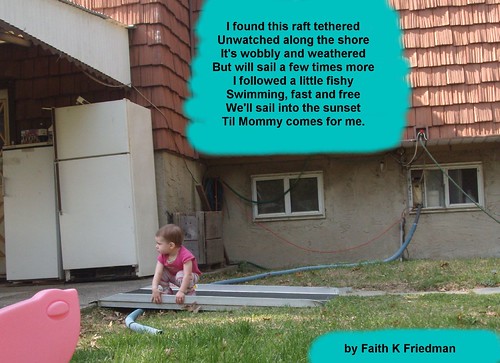
This beautiful piece of art was made for me by my sister. It is the first part of a series portraying the innocence of the interactions between children and disability.
[Description: A child squats on a wheelchair ramp leading up to a patio, grasping the side, gazing perpendicular to the camera. The yard around her is replete with backyard paraphenalia. In a thought bubble on the top right, is the following poem:
I found this raft tethered
Unwanted along the shore
Its wobbly and weathered
But will sail a few times more
I followed a little fishy
Swimming, fast and free
We'll sail into the sunset
'Till Mommy comes for me
by Faith K Friedman]
May 20, 2008
Impairment and Spirituality
Disclaimer: Normally I'm not much of a preacher, unless someone asks. Ryn asked :P I also apologize if it is excessively rambling.
Before I am anything else, I am a disciple of Christ. When I lost my memories and personality and my brain blew up for almost a year, I was a different person in almost every way. I forgot my friends, barely remembered my family, changed from outgoing to shy, lost my pride, lost myself. The one thing I did not lose, one of the few constants in my life at that time was his presence in my life, and my faith in him. I was not as mature a christian, I was more prickly and easier offended about my faith, but that faith never left me.
My belief in God is the lense I see the world through, it is the deepest and most immovable part of me. One of the few things that is understood about my disabilities from a medical perspective is that there is a lot of congenital involvement. Thus, to be consistent in my beliefs, I cannot come to any conclusion other than this:
God created me knowing I would be a crip.
That conclusion, which looks so simple written down, took me a decade to work through. The implications were huge, and accepting it was difficult. I tried to forget it, ignore it, deny it, but I cannot. If I believe that God is the omniscient creator of every human being, that we are fearfully and wonderfully and individually made, then God made me. He made me knowing what he was making, what would happen, and with a purpose in mind. He knew what my life would be like, and saw worth and value in it.
Some folks who have claimed to share my faith have claimed that disability is the result of sin, using sin as a word for individual misbehavior and tradition breaking. I vehemently disagree with both their conclusions and definition of sin. People aren't born disabled because of a sinful last life. We aren't bearing the misdeeds of mom or dad, nor are we being punished for what we might have done otherwise. Living a virtous life cannot save you or your children from impairment. We are simply affected, as all creatures are in one way or another, by the darkness that has taken root in both the physical and spiritual manifestations of the world.
I am not any more broken than the world I was born into. Sin is real, and its effects are evident everywhere in the corruption and entropy of our world. Huge regions of the world with no potable water are a sign of it, just as surely as the lack of caring for the people who live there by those who don't. As a people, we try to distract ourselves from the suffering around us, we blame the victims for being "lazy", we selfishly try to hold on to however much we can get, we discount the value of others. We try our best to prosper, heedless to the cost of other human's lives. Dehumanization is rampant, because without it the masses can't feel good about their lifestyle. All the while, the news anchors treat stories about thousands of Iraqis dying under occupation with the same brevity as stories about the local prom queen being arrested for scanty clothing. The world is broken.
People are born as parts of this broken world. We are born seperated from God, mired in this world, in darkness. No one makes a big deal about this congenital spiritual impairment, just as no one rants about humanity's lack of ability to fly: it is the norm. Physical and mental impairments are to be fought, resisted, driven out, but spiritual impairments are "best dealt with privately". Christ had different priorities. In fact, when he was walking this earth he healed physical and mental impairments as mere lead up miracles, to show the concept. The real work was giving a way for people to be healed of their spiritual impairment.
So where does that leave me? I've devoted myself to God, and he thinks spiritual healing is more important than physical healing. I have accepted that, and more than accepted that: I am beginning to understand. The love for my fellows (even when accompanied by grief and sorrow), empathy, patience, grace, faithfulness, and joy that he has filled me with over the years are better than hearing and walking. Society says I am the broken one, the sufferer, survivor of tragedy. I think it's the other way around. Society fears and others us because we visibly show how broken it's world really is, and force it to deal with the problems it would rather ignore.
Before I am anything else, I am a disciple of Christ. When I lost my memories and personality and my brain blew up for almost a year, I was a different person in almost every way. I forgot my friends, barely remembered my family, changed from outgoing to shy, lost my pride, lost myself. The one thing I did not lose, one of the few constants in my life at that time was his presence in my life, and my faith in him. I was not as mature a christian, I was more prickly and easier offended about my faith, but that faith never left me.
My belief in God is the lense I see the world through, it is the deepest and most immovable part of me. One of the few things that is understood about my disabilities from a medical perspective is that there is a lot of congenital involvement. Thus, to be consistent in my beliefs, I cannot come to any conclusion other than this:
God created me knowing I would be a crip.
That conclusion, which looks so simple written down, took me a decade to work through. The implications were huge, and accepting it was difficult. I tried to forget it, ignore it, deny it, but I cannot. If I believe that God is the omniscient creator of every human being, that we are fearfully and wonderfully and individually made, then God made me. He made me knowing what he was making, what would happen, and with a purpose in mind. He knew what my life would be like, and saw worth and value in it.
Some folks who have claimed to share my faith have claimed that disability is the result of sin, using sin as a word for individual misbehavior and tradition breaking. I vehemently disagree with both their conclusions and definition of sin. People aren't born disabled because of a sinful last life. We aren't bearing the misdeeds of mom or dad, nor are we being punished for what we might have done otherwise. Living a virtous life cannot save you or your children from impairment. We are simply affected, as all creatures are in one way or another, by the darkness that has taken root in both the physical and spiritual manifestations of the world.
I am not any more broken than the world I was born into. Sin is real, and its effects are evident everywhere in the corruption and entropy of our world. Huge regions of the world with no potable water are a sign of it, just as surely as the lack of caring for the people who live there by those who don't. As a people, we try to distract ourselves from the suffering around us, we blame the victims for being "lazy", we selfishly try to hold on to however much we can get, we discount the value of others. We try our best to prosper, heedless to the cost of other human's lives. Dehumanization is rampant, because without it the masses can't feel good about their lifestyle. All the while, the news anchors treat stories about thousands of Iraqis dying under occupation with the same brevity as stories about the local prom queen being arrested for scanty clothing. The world is broken.
People are born as parts of this broken world. We are born seperated from God, mired in this world, in darkness. No one makes a big deal about this congenital spiritual impairment, just as no one rants about humanity's lack of ability to fly: it is the norm. Physical and mental impairments are to be fought, resisted, driven out, but spiritual impairments are "best dealt with privately". Christ had different priorities. In fact, when he was walking this earth he healed physical and mental impairments as mere lead up miracles, to show the concept. The real work was giving a way for people to be healed of their spiritual impairment.
So where does that leave me? I've devoted myself to God, and he thinks spiritual healing is more important than physical healing. I have accepted that, and more than accepted that: I am beginning to understand. The love for my fellows (even when accompanied by grief and sorrow), empathy, patience, grace, faithfulness, and joy that he has filled me with over the years are better than hearing and walking. Society says I am the broken one, the sufferer, survivor of tragedy. I think it's the other way around. Society fears and others us because we visibly show how broken it's world really is, and force it to deal with the problems it would rather ignore.
May 13, 2008
And Now, For Something Completely Different...
Speaking of a video game the other night, my sister said, "The background music is beautiful if you can hear it through the violence." That sentence has rolled around my brain for almost a full day now, for it rings so true on so many levels.
Terrible things are happening all over the world, large scale atrocities mixing with personal tradgedies and disappointments. The strong get stronger, the weak are oppressed, the global economy frantically seeks to stop drowning. And yet... just sitting with my niece on my knee, reading BADD posts out loud to her so she'll settle down and stop poking my monitor, I can hear that beautiful background music that is the little goodnesses of life. Eating a really tasty meal, enjoying a good movie, resting in my husband's embrace: all of these things may not be greater than a horrific earthquake in China, but they are beautiful, and they are important. They are both what make life livable and wonderful, despite all the flak in the air.
Life with disability is just the same. There's a lot of pain, a decent dose of humiliation, isolation, and frustration. I'm not happy I was stuck in bed yesterday morning, uncrossable feet from the medicine I needed, but if I had missed it, I would also have missed perhaps the cuddliest time I have ever had with my dog. Without my regular mobility impairment, I would not have the fun of screeching around at top speed in my 'chair. There is background music, and it is very pretty.
There are small joys everywhere, just waiting to be noticed and acknowledged. I resolve to do my best to deal with the violence as I can, and listen to the music always.
(Ironically, in the original context of my sister's quote, I could not hear the music. In fact, I couldn't hear the violence either, unless I really tried at it. I'm just trusting her that there were sounds of violence and music to be heard. Go go gadget audio processing disorder!)
Terrible things are happening all over the world, large scale atrocities mixing with personal tradgedies and disappointments. The strong get stronger, the weak are oppressed, the global economy frantically seeks to stop drowning. And yet... just sitting with my niece on my knee, reading BADD posts out loud to her so she'll settle down and stop poking my monitor, I can hear that beautiful background music that is the little goodnesses of life. Eating a really tasty meal, enjoying a good movie, resting in my husband's embrace: all of these things may not be greater than a horrific earthquake in China, but they are beautiful, and they are important. They are both what make life livable and wonderful, despite all the flak in the air.
Life with disability is just the same. There's a lot of pain, a decent dose of humiliation, isolation, and frustration. I'm not happy I was stuck in bed yesterday morning, uncrossable feet from the medicine I needed, but if I had missed it, I would also have missed perhaps the cuddliest time I have ever had with my dog. Without my regular mobility impairment, I would not have the fun of screeching around at top speed in my 'chair. There is background music, and it is very pretty.
There are small joys everywhere, just waiting to be noticed and acknowledged. I resolve to do my best to deal with the violence as I can, and listen to the music always.
(Ironically, in the original context of my sister's quote, I could not hear the music. In fact, I couldn't hear the violence either, unless I really tried at it. I'm just trusting her that there were sounds of violence and music to be heard. Go go gadget audio processing disorder!)
May 1, 2008
Through the Mountains and the Valleys
Who defines my identity? I've realized the answer is very simple: only I can. It took a while to get there, unfortunately.
The world would have you believe I'm a woman with unrealized potential, cut off from the world of success that everyone must aspire to by a tragic set of disabilities. The world would have it that my gifts are squandered on life as a home maker, and that if only my body were whole I would have "made something" of myself. For a while, I believed all of that, too. I bought into it, made it part of my identity.
The first challenge came when I realized I was not much of a woman. In fact, even before becoming comfortable with my own genderqueerness, I still never identified as a woman. I tried, but I could never feel like I was part of that world. I poked fun at both genders with wild abandon, feeling above that fray and certainly not included in the group being insulted in either case. I understood on an instinctive level testosterone wars, made friends in a way more traditionally male, and my wedding party had more guys than gals in it. (My friends largely refer to me as "a Tokah" and feel no need to define it past there, bless them.)
After that, my progressive disabilities began... progressing (go figure!) and the whole identity knot started to unravel. At the same time, I felt I was very much growing internally and that my life was becoming richer. This clashed with my former identity complex, the society imposed one, and since then its been a rocky but worthwhile trip to define myself.
A very common way to define oneself is through paid employment and education. While I am capable of short stints of it, my body hasn't cooperated for years in letting me keep a long term job or get anywhere in the academic system. I've gotten to try a lot of things, meet a lot of cool people, and get all sorts of different perspectives, but I haven't been able to keep up an out-of-the-house gig long enough to define myself by it since 2002.
For a few years, I tried the "chippy martyr" identity. The problem is, after a few years it gets stale: not just for your friends, but you as well. Its hard to get on with growing and enjoying your life when you focus on the pain, the suffering, the challenges of living with a disability all the time. (This is especially true when you have not yet admitted you have a disability!)
So, there I was, on the road to shrugging off society's definitions and finding my own. I had figured out and become comfortable with myself as a not-quite-woman, as a gamer, as a Christian, and I had finally given up on my martyr complex. This was a pretty rough time in my life, as I was slowly giving myself malnutruition by my inability to make it to my kitchen coupled with my inability to admit I needed help. I had been using crutches daily for some time, but at this point those were no longer enough. I grit my teeth, ordered a hospital-style wheelchair, and promised myself it was just for "long trips". At this point, I somehow still didn't believe I had a disability.
The day I accepted that I was disabled was the day I realized I hadn't showered in three weeks. I had been waiting for that good day where I'd feel good enough to make the step into the shower, and it hadn't come. That day, I came to understand that good day might never come again, and that I stunk. I admitted to myself, and to my family, that I in fact needed something far more stigmatized than a wheelchair in my mind: a shower chair. My pop got me one, and I had the first nice shower in a decade. That was the turnaround point, and the beginning of my assumption of disability into my identity.
To this day, it amazes me that it took so long. I have been hard of hearing all my life, and its impacted everything I do as I struggled to learn to interface with a world that speaks only in mumbles. I did identify with other people with hearing difficulties, took offense to "What did you say?" jokes, but never thought of myself as a PWD. Truly, I still mostly think of myself as the norm, and those hearing people as the weird ones. I understand intellectually that's not really true, but I can't get past that perception.
No, it was the day I ordered a shower chair that I realized I had a disability. Being a know it all and a self educator, I dove into the internet's trove of disability info. Years later, I haven't made my way out of that deep pool, but it has changed me to the core. I found that I was disabled, that it was ok... not only just ok, but something many people were proud of. I found out that I wasn't alone, that my particular disability story was all over the 'net and the globe, repeated in dozens of lives. I learned about the importance of independence and function over mimicking the AB world's way of doing things. I was infused with the knowledge I could do lots of things most people (including myself) though I coudn't, with thought, appropriate bits of equipment, and an open mind.
I found the freedom to be a crip, and with it came the freedom to be myself without embarassment. I don't have to conform to other people's views of what I should be trying to accomplish or how I should be trying to accomplish it. My friends and family have the freedom to expect help and contribution from me, as long as they're willing to work with me on enablement and open their minds a little bit. This freedom took me out of the prison of my bedroom, allowing me to care for my niece, help my buddies paint their house, go camping, and experience a wide world of activities I had once thought dead to me.
Subsuming "crip" into my identity also allowed me to see what I can contribute instead of what I can't. I will probably never be the bread earner for my family, but I put delicious meals on the table for them, write campaigns and adventures that entertain us cheaply every weekend, nourish their emotional lives, and serve as our social group's activities coordinator. I bring people together, help people through their hard times, and I can only do these things because I have perspective, empathy, and time.
When I was a teenager, I thought that at this age I would be in residency at a hospital as a doctor, a respected professional. If I were to go back and show that teenage me a bit of my current life, that teenage me would probably be incredibly disappointed in her future self. Identity is a journey, and there are no shortcuts to be had. The only way to get there is by living it.
To me, to indentify as disabled is more than just being part of a minority, more than just advocacy or even pride. (I don't dismiss advocacy, it is also incredibly important, from the smallest nudge in casual conversation to protests in the capital.) It is about a different perspective on life, a willingness to step up and learn a different way of living, traveling off of the beaten path, realize the grind, the "standard" life isn't for you and that there's nothing wrong with that.
The world would have you believe I'm a woman with unrealized potential, cut off from the world of success that everyone must aspire to by a tragic set of disabilities. The world would have it that my gifts are squandered on life as a home maker, and that if only my body were whole I would have "made something" of myself. For a while, I believed all of that, too. I bought into it, made it part of my identity.
The first challenge came when I realized I was not much of a woman. In fact, even before becoming comfortable with my own genderqueerness, I still never identified as a woman. I tried, but I could never feel like I was part of that world. I poked fun at both genders with wild abandon, feeling above that fray and certainly not included in the group being insulted in either case. I understood on an instinctive level testosterone wars, made friends in a way more traditionally male, and my wedding party had more guys than gals in it. (My friends largely refer to me as "a Tokah" and feel no need to define it past there, bless them.)
After that, my progressive disabilities began... progressing (go figure!) and the whole identity knot started to unravel. At the same time, I felt I was very much growing internally and that my life was becoming richer. This clashed with my former identity complex, the society imposed one, and since then its been a rocky but worthwhile trip to define myself.
A very common way to define oneself is through paid employment and education. While I am capable of short stints of it, my body hasn't cooperated for years in letting me keep a long term job or get anywhere in the academic system. I've gotten to try a lot of things, meet a lot of cool people, and get all sorts of different perspectives, but I haven't been able to keep up an out-of-the-house gig long enough to define myself by it since 2002.
For a few years, I tried the "chippy martyr" identity. The problem is, after a few years it gets stale: not just for your friends, but you as well. Its hard to get on with growing and enjoying your life when you focus on the pain, the suffering, the challenges of living with a disability all the time. (This is especially true when you have not yet admitted you have a disability!)
So, there I was, on the road to shrugging off society's definitions and finding my own. I had figured out and become comfortable with myself as a not-quite-woman, as a gamer, as a Christian, and I had finally given up on my martyr complex. This was a pretty rough time in my life, as I was slowly giving myself malnutruition by my inability to make it to my kitchen coupled with my inability to admit I needed help. I had been using crutches daily for some time, but at this point those were no longer enough. I grit my teeth, ordered a hospital-style wheelchair, and promised myself it was just for "long trips". At this point, I somehow still didn't believe I had a disability.
The day I accepted that I was disabled was the day I realized I hadn't showered in three weeks. I had been waiting for that good day where I'd feel good enough to make the step into the shower, and it hadn't come. That day, I came to understand that good day might never come again, and that I stunk. I admitted to myself, and to my family, that I in fact needed something far more stigmatized than a wheelchair in my mind: a shower chair. My pop got me one, and I had the first nice shower in a decade. That was the turnaround point, and the beginning of my assumption of disability into my identity.
To this day, it amazes me that it took so long. I have been hard of hearing all my life, and its impacted everything I do as I struggled to learn to interface with a world that speaks only in mumbles. I did identify with other people with hearing difficulties, took offense to "What did you say?" jokes, but never thought of myself as a PWD. Truly, I still mostly think of myself as the norm, and those hearing people as the weird ones. I understand intellectually that's not really true, but I can't get past that perception.
No, it was the day I ordered a shower chair that I realized I had a disability. Being a know it all and a self educator, I dove into the internet's trove of disability info. Years later, I haven't made my way out of that deep pool, but it has changed me to the core. I found that I was disabled, that it was ok... not only just ok, but something many people were proud of. I found out that I wasn't alone, that my particular disability story was all over the 'net and the globe, repeated in dozens of lives. I learned about the importance of independence and function over mimicking the AB world's way of doing things. I was infused with the knowledge I could do lots of things most people (including myself) though I coudn't, with thought, appropriate bits of equipment, and an open mind.
I found the freedom to be a crip, and with it came the freedom to be myself without embarassment. I don't have to conform to other people's views of what I should be trying to accomplish or how I should be trying to accomplish it. My friends and family have the freedom to expect help and contribution from me, as long as they're willing to work with me on enablement and open their minds a little bit. This freedom took me out of the prison of my bedroom, allowing me to care for my niece, help my buddies paint their house, go camping, and experience a wide world of activities I had once thought dead to me.
Subsuming "crip" into my identity also allowed me to see what I can contribute instead of what I can't. I will probably never be the bread earner for my family, but I put delicious meals on the table for them, write campaigns and adventures that entertain us cheaply every weekend, nourish their emotional lives, and serve as our social group's activities coordinator. I bring people together, help people through their hard times, and I can only do these things because I have perspective, empathy, and time.
When I was a teenager, I thought that at this age I would be in residency at a hospital as a doctor, a respected professional. If I were to go back and show that teenage me a bit of my current life, that teenage me would probably be incredibly disappointed in her future self. Identity is a journey, and there are no shortcuts to be had. The only way to get there is by living it.
To me, to indentify as disabled is more than just being part of a minority, more than just advocacy or even pride. (I don't dismiss advocacy, it is also incredibly important, from the smallest nudge in casual conversation to protests in the capital.) It is about a different perspective on life, a willingness to step up and learn a different way of living, traveling off of the beaten path, realize the grind, the "standard" life isn't for you and that there's nothing wrong with that.
Subscribe to:
Posts (Atom)
